
Hetauda
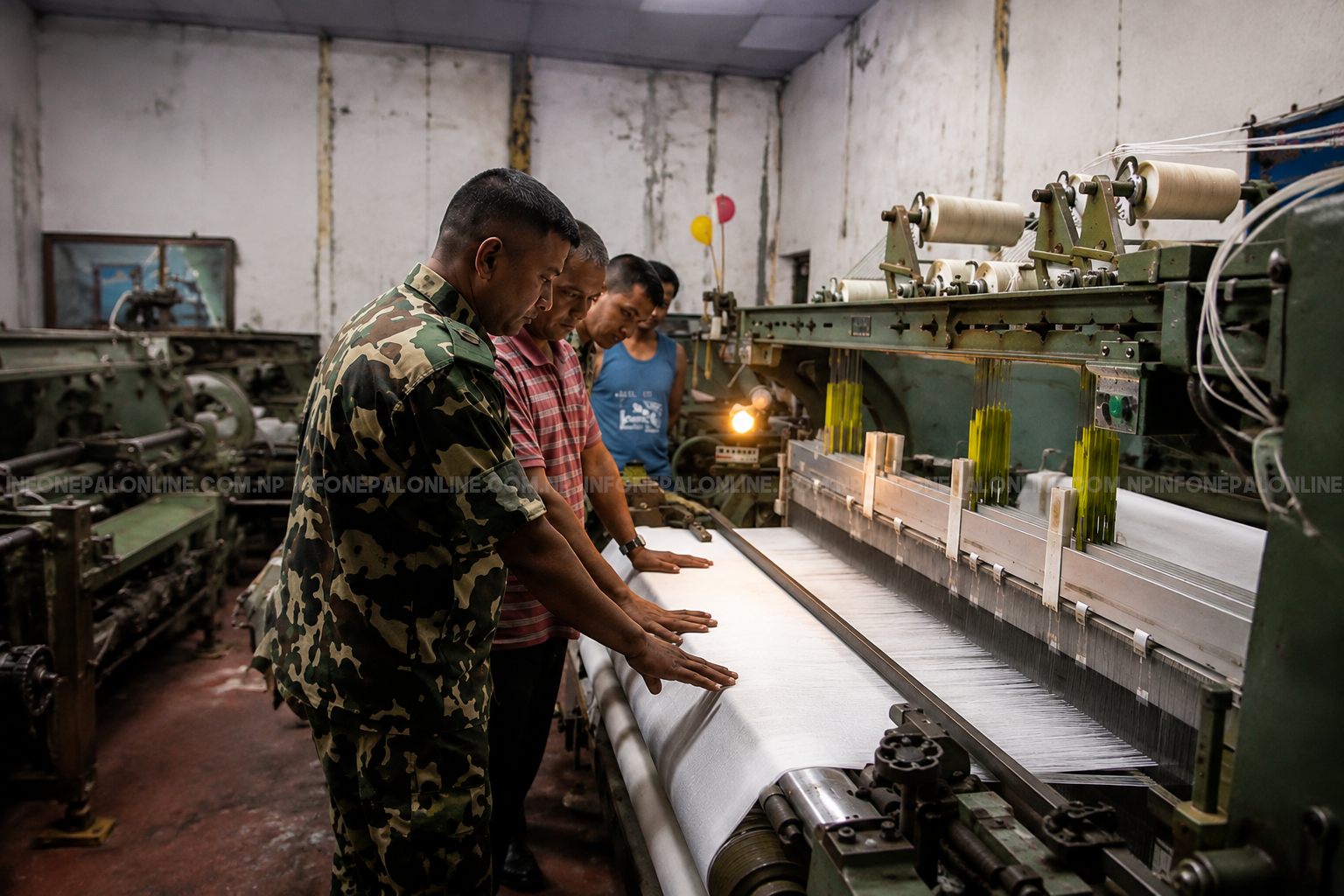
Trial production has started at the long-closed Hetauda Textile Industry, with 20 looms currently being used to weave fabric.
The government is also preparing to study whether the factory’s old machinery can be upgraded with modern technology and used for commercial production.
Minister for Science, Technology and Innovation Mahabir Pun inspected the state-owned factory in Hetauda Sub-Metropolitan City–8 on Friday. He received information about the condition of the machines, ongoing repairs, trial production and the challenges involved in reviving the industry.
The Hetauda Textile Industry has a total of 488 machines. The Nepal Army has cleaned and repaired part of the machinery, allowing trial production to begin on 20 looms. The remaining machines are still undergoing inspection and maintenance.
Yarn is currently being brought from outside the factory to test the production capacity and condition of the old looms.
Pun said obtaining spare parts would be one of the biggest challenges because the Chinese company that manufactured the machines has already shut down. However, he said production could still be possible if the existing machinery is modified and connected with modern technology.
The minister said his visit was aimed at studying how old state-owned industries could be revived through research, innovation and technological development.
According to Pun, reopening the factory should involve more than cleaning and repairing old machines. A separate research and innovation unit may be required to develop replacement parts, upgrade the machinery and determine a sustainable production model.
Technical Assistant Major General Mukesh Bataju, director of the Directorate of Military Materials Production, briefed the minister on the condition of the factory, the progress of repairs and the ongoing trial production.
Government provides Rs 3.3 million for trial production
The government decided on Ashar 18 to bring the Hetauda Textile Industry back into operation. Following the decision, cleaning, electrical system upgrades and machine repairs were carried out inside the factory.
The government has provided Rs 3.3 million for trial production. The current testing process is expected to determine how much fabric the repaired machines can produce and whether operating the factory on a larger scale would be technically and financially practical.
The Hetauda Textile Factory has remained closed since BS 2057, or around 2000/01. Several plans to revive it were discussed over the years, but the factory had remained inactive.
The latest trial marks a practical attempt to restart production, although a final operational model has yet to be determined. The results from the 20 working looms could help the government assess the required investment, production capacity and future management structure.
Research centre proposed in Birgunj
During the visit, Pun also proposed establishing a research centre on about four bighas of land at the Agricultural Tools Factory in Birgunj.
He estimated that between Rs 700 million and Rs 800 million would be required to establish the proposed centre. Pun said cooperation with the Nepal Army could support research, technological development and the revival of old industrial machinery.
Related stories

How to Secure Your Facebook and Instagram in 2025
In 2025, cyber threats in Nepal have become more common than ever. Facebook and Instagram are not just social platforms anymore — they’re vital for communication, business, content…
Share Market : 10 things investors need to know
We can find many examples of significant income from the stock market. However, it is not easy to make a lot of money from the stock market. Not only sound education but his alertn…

The effect of Tik Tok Live: In the water day and night to get a gift!
Kathmandu. No income can be made by posting videos on Tiktok, which is known as a short-video sharing platform. For example, when you upload a video on YouTube, you can earn money…
35 lakh scholarship will be given to MBBS students
Kathmandu. To the students studying 'MBBS' in Patarasi rural municipality of Jumla, the municipality will give Rs. 35 lakh scholarship will be given. Village Chairman Purna Singh B…