

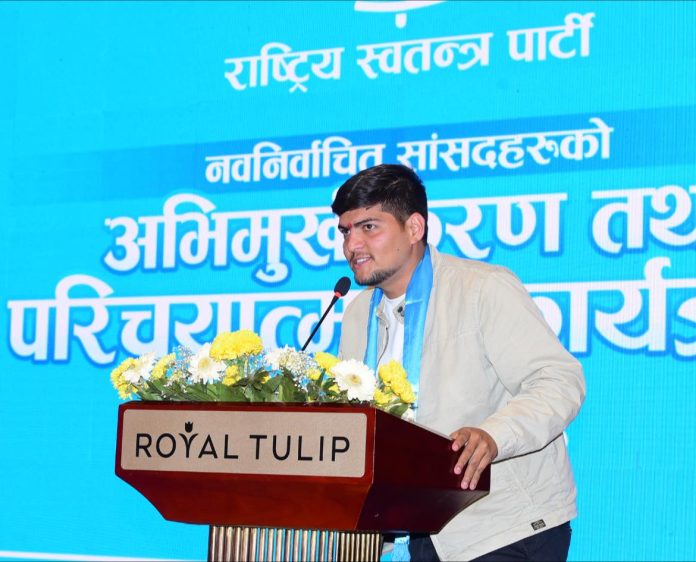
Hetauda | Not so many years ago, a 12-year-old boy could be seen sprinting through the lanes of Manahari in the early morning light, a bundle of newspapers tucked under his arm. Delivering papers door to door was how he began each day. But for him, those newspapers were never just sheets of paper they were windows into the country’s politics and society.
That boy, Prashant Upreti, who once eagerly read every headline he delivered, has today become a headline himself as Nepal’s youngest Member of Parliament.
Roots and Early Life
Prashant’s home is Manahari-7, Makwanpur. Though his ancestral roots lie in Kavrepalanchok, his grandfather had migrated from the hills to Sarlahi in search of better farmland. When that didn’t work out, the family eventually settled in Manahari — clearing jungle and building a settlement without land ownership documents. Prashant was born there.
“I myself fall under the category of informal settlers. Even though I’m not technically a squatter, I’ve closely felt the pain of not having land registration papers and understood the struggles of landless people,” he says.
Without official land certificates, the people of his community face barriers in banking, legal processes, and running businesses.
His father worked as a teacher, and the family ran a small stationery shop. Delivering newspapers from the shop to customers’ homes was Prashant’s responsibility.
“I don’t even know when the habit of reading headlines while delivering papers turned into a genuine interest in politics,” he recalls with a smile.
Even in school, Prashant stood apart. While others studied textbooks, he hid books of general knowledge inside them. He consistently excelled in quizzes, debates, and public speaking. His curiosity about current affairs set him well ahead of his peers, and he naturally gravitated toward friendships with older, more experienced people.
Kathmandu, MRR, and Social Work
After completing his SLC from United Secondary School in Makwanpur, Prashant moved to Kathmandu in 2016 to pursue his Plus Two in Management at Global College of Management.
The city opened a new chapter in his life. Through a Facebook group called Men’s Room Reloaded (MRR) open only to men above 18 he connected with Victor Poudel, Kumar Ben, KP Khanal, Bablu Gupta, and others who would later become the core team behind Balen Shah’s historic mayoral campaign.
Spending two to four hours daily in tea shops debating politics with this group sharpened his political thinking considerably.
Prashant was also a founding member of Aamaaghar, a shelter home for single, homeless, and elderly individuals who have no family support. He currently serves there as an advisor.
He was also associated with the Mainadevi Foundation, run by fellow newly-elected MP KP Khanal, and regularly showed up at Maitighar to support Dr. Govinda KC’s movement for medical education reform.
Additionally, he is a member of the “100 Group”, led by MP Bablu Gupta, which provides full scholarships including accommodation and meals for students transitioning from SEE to Plus Two.
When Bablu Gupta became a minister, Prashant worked informally at his secretariat to assist him, even without any official title.
Helping Balen Win
When Balen Shah decided to run as an independent candidate for Mayor of Kathmandu in the 2082 (2025) local elections, Prashant and his friends threw themselves into the campaign.
“In the early days of door-to-door campaigning, we’d rarely gather more than five to seven people. When people asked which party we were from, we’d say ‘independent,'” Prashant recalls. “Later we put out a call through MRR.”
Members of the group across Kathmandu began asking their own landlords and neighbors to vote for Balen. The “Ask Your Landlord to Vote” campaign, which Prashant’s group spearheaded, became one of the most effective grassroots tools of the election. Then Balen’s old rap videos and interviews went viral, and momentum surged.
After Balen won, Prashant continued to support him working at the mayoral secretariat on youth mobilization, heritage preservation initiatives, and volunteering at cultural festivals.
Alongside his social work, Prashant pursued a Bachelor’s degree from the Nepal Academy of Tourism and Hotel Management (NATHAM), and is currently completing a Master’s in Leadership and Management from Kathmandu University.
During his undergraduate years, he co-founded Sanatan Yatra Pvt. Ltd., a travel agency, with his friend Rishabh Chalise. A year later, he partnered with Bipin Khadka to open Hotel Ellivay Express in Thamel.
He also taught Social Studies to Grade 9 and 10 students at his former school, United Secondary School, for nine months though he stopped once he decided to enter the election.
Prashant and his circle had originally planned to contest the 2084 (2027) parliamentary elections. But the Gen-Z Movement brought down Prime Minister KP Oli’s government ahead of schedule, and snap elections were announced. Prashant happened to be in Makwanpur when the movement erupted.
By the time elections were called for Falgun 21, Prashant had turned exactly 25 — just old enough to be eligible. Rastriya Swatantra Party (RSP) gave him a ticket.
During door-to-door campaigning, many voters were skeptical: “What can this young boy possibly do?”
But the results far exceeded expectations. He won on his first attempt.
Now, when he visits voters to thank them, many ask “Are you the one they call Balen?” leaving him momentarily speechless.
“The votes we received represent not only the hope for change, but also the frustration with old political parties. People even those loyal to established parties voted for us because they want something different,” he says.
Notably, his father Ramchandra, who had been a member of CPN-UML since 1991, resigned from the party after Prashant received RSP’s candidacy.
The real challenge now lies ahead: proving himself through action. Prashant is committed to integrity.
“Never dig a pit that you yourself might fall into someday because a pit doesn’t recognize its master,” he says, with the quiet confidence of someone who has already walked a long road to get here.
