

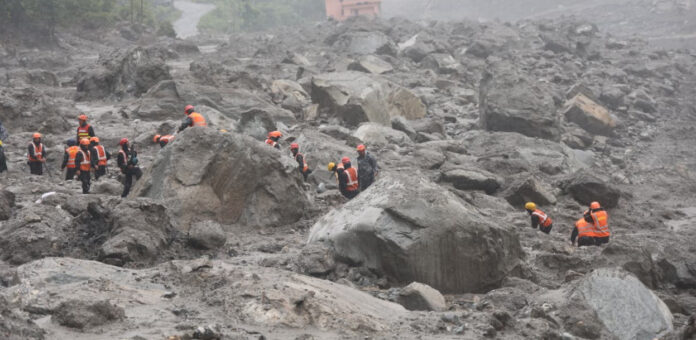
KATHMANDU — At around 8:40 am on August 26, 2026, a destructive surge entered Nepal through the Bhote Koshi River in Rasuwa, carrying water, mud, rocks and other debris into the Trishuli river system.
Within days, bodies were being recovered hundreds of kilometres downstream in Chitwan, Tanahun, Gorkha and both eastern and western Nawalparasi. Roads and bridges were washed away, hydropower workers were trapped underground, communications collapsed and thousands of residents, workers and travellers were cut off.
By 5:30 pm on Saturday, August 29, the Government of Nepal said 675 bodies had been recovered and 7,514 people had been brought to safety through air and ground operations.
However, the latest government statement did not publish a revised figure for people still unaccounted for. The most recent consolidated missing-person report remains the National Disaster Risk Reduction and Management Authority’s 10 am figure of 2,426.
These numbers require careful interpretation. They come from different agencies, geographical areas and reporting times. “Reported missing” does not automatically mean confirmed dead, while rescue figures issued separately by the police, Army and disaster authority must not be added together.
The disaster at a glance
| Indicator | Latest available official figure | Cut-off |
|---|---|---|
| Bodies recovered | 675 | August 29, 5:30 pm |
| People rescued or evacuated | 7,514 | August 29, 5:30 pm |
| Reported out of contact | 2,426 | August 29, 10 am |
| People rescued from hydropower areas | 279 | August 29, 5:30 pm |
| Security personnel deployed | 18,708 | August 29, 5:30 pm |
| Helicopters mobilised | 16 | August 29 |
| Helicopter flights completed | 236 | By 5:30 pm |
| Displaced people in temporary accommodation | Around 3,500 | August 29 |
| Relief camps | 18—three in Rasuwa and 15 in Nuwakot | August 29 |
| Mobile towers operating | 161 of 198 | August 29 |
| Emergency funds released to local governments | Rs 67.5 million | By August 28 |
Data note: The latest figures were released by Prime Minister Balendra Shah with a 5:30 pm cut-off. The missing-person figure is from the NDRRMA’s 10 am report because the evening statement did not provide a revised total.
What happened on the morning of August 26?
The Office of the Prime Minister and Council of Ministers recorded the disaster at 8:40 am on Wednesday, August 26. The flood first caused extensive destruction along the Bhote Koshi corridor in Rasuwa before entering the Trishuli River and moving through Nuwakot, Dhading and districts farther downstream.
The International Centre for Integrated Mountain Development said water levels in the Bhote Koshi basin began rising rapidly at around 9 am. The flood moved not as ordinary river water alone, but as a high-energy mixture of water, sediment, rocks and boulders.
Hydrological observations illustrate its exceptional speed. The Trishuli River reportedly rose by as much as nine metres within 30 minutes at Galchhi and by seven metres over a similar period at Malekhu. Some river-monitoring stations were damaged or washed away.
This helps explain why the disaster affected such a long corridor. The flood did not remain confined to the location where it first entered Nepal. It followed the connected Bhote Koshi–Trishuli–Narayani river system, carrying people, vehicles, structures and debris far downstream.
What caused the flood?
The exact cause has not yet been conclusively established.
Preliminary assessments by ICIMOD and other scientists indicate that a large ice-rock avalanche may have occurred in a high-altitude area upstream. Ice and rock debris may have entered the Lhende Khola, a tributary of the Bhote Koshi, temporarily blocking the river before impounded water and debris were suddenly released.
Scientists are also studying unusual seismic signals recorded around the time of the disaster. But ICIMOD said no causal connection between seismic activity and the flood had been established. It also cautioned that although climate change is altering glaciers, permafrost, snowfall and mountain slopes, it is too early to determine its precise role in this particular event.
The Ministry of Foreign Affairs similarly said on Saturday that the cause had not been fully determined.
Therefore, descriptions such as “glacial lake outburst,” “earthquake-triggered flood” or “cloudburst” should not be presented as confirmed conclusions. The most accurate description at this stage is a major debris-laden flash flood, possibly associated with an upstream ice-rock avalanche and temporary river blockage.
Why were bodies recovered so far downstream?
Nepal Police’s 3:30 pm update on Saturday recorded 669 recovered bodies across eight districts:
| District where bodies were recovered | Number |
|---|---|
| Rasuwa | 13 |
| Nuwakot | 41 |
| Dhading | 49 |
| Chitwan | 248 |
| Gorkha | 54 |
| Tanahun | 31 |
| Nawalparasi East | 158 |
| Nawalparasi West | 75 |
| Total | 669 |
By 5:30 pm, the government’s consolidated number had increased to 675. The location of the six additional recoveries was not specified in the Prime Minister’s statement.
These figures show where bodies were found, not necessarily where each person entered the flood. A person swept away in Rasuwa or Nuwakot could have been recovered days later in Chitwan or Nawalparasi.
Identification, therefore, requires coordination among police offices, hospitals, district administrations and families in several districts.
Why do official figures keep changing?
The changing figures do not always represent new deaths, rescues or missing cases during the period between two updates.
They may also reflect:
- Newly reached communities and workplaces
- Additional reports submitted by families
- Duplicate names removed from lists
- People restoring contact after phone services return
- Bodies or human remains being counted and classified
- Transfer of records between districts
- Differences between agency-specific and national consolidated figures
- Corrections to the district where a body was recorded
For example, Nepal Police reported 616 recovered bodies at 6 am on Saturday. NDRRMA’s 10 am report raised the number to 626. Police increased it to 669 by 3:30 pm, and the government’s 5:30 pm consolidated statement placed it at 675.
District figures have also been revised. NDRRMA’s 10 am report listed 51 recoveries in Nuwakot, while the later police breakdown listed 41. Earlier police updates had also listed 17 recoveries in Rasuwa before revising the district figure to 13. Such revisions show that disaster data is being reconciled as identification and verification continue.
How many people are missing?
NDRRMA reported 2,426 people out of contact at 10 am on Saturday. The figure included 933 hydropower workers, members of the security agencies, customs and immigration personnel, residents, travellers and foreign nationals.
It is a report-based total, not a verified count of people physically trapped or presumed dead.
Damaged electricity and telecommunication systems prevented many survivors from contacting their families. Some names may have been registered by more than one relative or district. Others may remain on the list even after reaching a safe location until the records are formally updated.
The latest evening government statement did not provide a revised missing-person number. It would therefore be inaccurate to subtract the 675 recovered bodies or 7,514 rescues directly from the 2,426 reports.
At 10 am, NDRRMA had also reported 101 injured people receiving hospital treatment and 15,224 security personnel deployed.
Why are there several rescue totals?
Nepal Police earlier reported rescuing 2,301 people—1,622 in Nuwakot, 676 in Rasuwa and three in Dhading. Police also reported that 140 injured people had received treatment or been discharged from hospitals in the Kathmandu Valley.
NDRRMA’s 10 am multi-agency total was 4,451, while the government’s 5:30 pm consolidated figure rose to 7,514.
The figures are not necessarily contradictory:
- The police figure represents a police operational count from specified districts.
- The Army separately maintains figures for people transported by military helicopters, vehicles and ground teams.
- NDRRMA consolidates information received from multiple agencies.
- The Prime Minister’s latest statement includes people moved to safety through both air and ground operations.
These totals must not be added together because the same person may already be included in the national consolidated count.
The rise from 4,451 at 10 am to 7,514 at 5:30 pm may include both new rescues and the consolidation of previously separate agency records. The government did not publish a district-wise breakdown explaining the full increase.
The high-risk tunnel operations
Hydropower projects became some of the most technically difficult rescue sites. Workers had taken shelter or become trapped inside tunnels and underground project structures after entrances and access roads were covered by mud and debris.
By Saturday afternoon, the Nepali Army had reported rescuing 208 people from the Trishuli-3 hydropower tunnel, including 38 Chinese and five Indian nationals. Rescue teams used drilling equipment to locate or reach the outer section of the tunnel.
The government’s 5:30 pm statement subsequently said 279 people had been rescued from different hydropower project areas. Because the later figure covers multiple project locations, it should not be treated simply as an updated total for the same Trishuli-3 tunnel.
An 11-member Indian technical reconnaissance team was deployed for specialised tunnel rescue. A six-member Chinese expert team was also mobilised to work with Nepali Army specialists at the Upper Trishuli-3B project. Nepal additionally requested technology to detect people who might still be alive, rapid DNA-testing support and mortuary facilities.
Helicopters, ground teams and difficult terrain
Sixteen helicopters belonging to the Nepali Army and private operators were used in the operation. By 5:30 pm Saturday, they had completed 236 flights.
The government said 18,708 personnel from the Nepali Army, Nepal Police and Armed Police Force had been deployed. Their responsibilities include:
- Searching for survivors and missing people
- Evacuating stranded residents and workers
- Transporting injured people
- Delivering food, medicine and shelter materials
- Recovering and managing bodies
- Clearing access routes
- Securing damaged or high-risk areas
Weather and terrain have limited the number of flights that can operate simultaneously. Roads, bridges and landing areas were damaged, while continued rain and the risk of landslides or renewed river surges complicated operations.
Indian and Chinese specialists were working in coordination with the Nepali Army in technically complex areas, according to the government.
Roads and bridges: the scale of the physical isolation
An initial Department of Roads assessment reported damage to at least 19 bridges and 40 kilometres of roads. A later assessment by the Ministry of Physical Infrastructure increased the number of damaged bridges to 41, including 13 in Rasuwa.
The road connecting Betrawati, Mailung, Syabrubesi and Rasuwagadhi suffered extensive damage. Around 40 kilometres of road in Rasuwa was reported severely damaged, while approximately 13 kilometres of the Prithvi Highway was covered by mud and debris.
The government had only seven 50-metre Bailey bridges in stock, leading authorities to seek additional temporary bridges from neighbouring countries.
By Saturday evening, an alternative Kathmandu–Tokha–Chhahare–Sarmathali–Kalikastan–Dhunche route had been repaired for small four-wheel vehicles, reconnecting Rasuwa to the national road network.
Mud was also cleared from the Galchhi–Malekhu section of the Prithvi Highway, restoring regular traffic. An alternative road to Dhadingbesi was reopened as well.
The reopening of these routes is important not only for public travel but also for moving fuel, food, medical supplies, heavy equipment and bridge components.
Power and hydropower losses
The flood directly damaged hydropower facilities, access roads, transmission infrastructure and project compounds.
An early Nepal Electricity Authority assessment said 11 hydropower plants and one solar facility were affected, disconnecting about 431.1 megawatts from the national grid. Six hydropower plants and one solar facility had suffered direct damage, while production from other projects was disconnected because of transmission or access problems.
The figure represents power removed from the grid at that stage, not a final assessment of permanently destroyed generation capacity.
A complete project-by-project engineering assessment will be required to determine structural damage, repair costs, worker casualties and the time needed to restore generation.
Communications: 161 of 198 towers operating
Before the flood, Nepal Telecom operated 120 BTS sites and Ncell operated 78 in the affected areas.
The government said services at 38 Nepal Telecom and 27 Ncell sites were disrupted by flood damage or lack of energy. Fuel, generators and solar panels were transported by helicopter and road to restore the networks.
By Saturday evening:
- 90 of Nepal Telecom’s 120 sites were operating.
- 71 of Ncell’s 78 sites were operating.
- A combined 161 of 198 sites were in service.
- Thirty-seven sites remained unavailable.
Restoring telecommunications is also essential for reconciling missing-person lists. Some people categorised as out of contact may be removed only after they can call their families or report to an official registration point.
Medical care and emerging health risks
Seriously injured survivors were transferred to hospitals in Kathmandu. Mobile hospitals were established at Nepali Army facilities in Dhunche and Battar, while medical teams were deployed to Dhunche, Syabrubesi, Rasuwa Hospital and two helicopter-accessible areas.
The government also said counselling was being offered to survivors and family members. A blood information portal was activated to show the availability of blood at hospitals.
WHO said around 10,000 households required immediate relief. Three health posts were completely damaged, one hospital was partially damaged and access to two hospitals was affected.
The organisation warned that displacement, overcrowding, damaged water and sanitation systems and interrupted health services could increase diarrhoeal and respiratory illnesses, unsafe food and water risks, vector-borne diseases and mental-health needs.
Fifteen municipalities were declared disaster crisis-affected areas for three months.
Temporary shelters and relief distribution
The government said approximately 3,500 displaced people had been placed in schools, public buildings and community facilities.
Three relief camps were established in Rasuwa and 15 in Nuwakot. The Nepal Red Cross, Nepal Scouts, Lions Clubs and other volunteer organisations were also mobilised.
NDRRMA released Rs 67.5 million to 15 local governments in five affected districts for essential services and immediate relief. The grants were to be distributed according to whether the local units were categorised as severely affected, affected or normally affected.
Relief supplies were being collected at Tribhuvan International Airport’s warehouse, the Kathmandu District Administration Office, the Nepal Police disaster training centre in Samakhusi and the Department of Urban Development and Building Construction premises in Babarmahal.
Materials were transported to distribution hubs in Battar, Uttargaya and Dhunche before being sent to affected communities through committees coordinated by district administrations.
Relief fund: what the balance means
The Prime Minister’s statement said accounts maintained at nine commercial banks under the Prime Minister’s relief mechanisms contained Rs 5,044,681,369 by Saturday noon. Another USD 1,808,189 was held in accounts at Himalayan Bank and Laxmi Sunrise Bank.
These amounts should be described as the reported balances in the designated accounts, not automatically as money donated exclusively after the August 26 flood. The government did not provide a breakdown separating earlier balances from new flood-related contributions.
The government has urged donors to use only the officially published QR code and accounts to reduce financial fraud and improve transparency.
International support: grants, loans and commitments are different
According to the Prime Minister’s statement, Nepal had received or secured commitments for several forms of international support:
- USD 5 million in proposed grant-based budget support from the Asian Development Bank
- USD 167 million in concessional financing from the World Bank
- USD 500,000 from the United States
- USD 1 million in cash support from Australia
- USD 150,000 in ADB technical assistance
- CHF 1 million from Switzerland, to be channelled through the United Nations
- 57.5 tonnes of humanitarian and medical assistance from India
A commitment, a grant, a concessional loan and technical assistance are not the same. They should be reported separately until agreements are signed and funds are disbursed.
Nepal has requested 30 Bailey bridges from China. The government also said 2,000 airtight body bags had been received from India and another 2,000 from China.
Finance Minister Swarnim Wagle separately estimated that reconstruction could require USD 4 billion to USD 5 billion—nearly one-tenth of Nepal’s economy. That is an early estimate, not an audited damage assessment or an approved reconstruction budget.
Identification and management of recovered bodies
The government said 675 bodies had been recovered by 5:30 pm Saturday.
Identified bodies are being handed over to families. When immediate identification is impossible, DNA samples, photographs, reference numbers and other identifying information are to be preserved before the government conducts final management under the amended directive on unidentified and unclaimed bodies.
The procedure is important because many bodies were carried far from their original locations. Identification may depend on DNA comparison, dental information, personal belongings or reports submitted by families in other districts or countries.
Authorities have asked the public not to assume that preservation of DNA followed by government-managed burial means identification efforts have ended.
Timeline: how the official figures changed
| Date and time | Major official development |
|---|---|
| August 26, 8:40 am | Government records the destructive flood entering the Bhote Koshi corridor in Rasuwa. |
| August 26, around 9 am | Rapid river rise observed; the surge moves into the Trishuli system. |
| August 26, 5 pm | Ministry of Foreign Affairs reports 72 recovered bodies and 403 people from 25 countries reported missing, subject to verification. |
| August 27, 5 pm | Nepal Police reports 359 deaths across eight districts. |
| August 28, 3 pm | Police reports 547 recovered bodies. |
| August 29, 6 am | Police count reaches 616 bodies. |
| August 29, 10 am | NDRRMA reports 626 bodies, 2,426 people out of contact, 4,451 rescued, 101 injured in hospitals and 15,224 security personnel deployed. |
| August 29, 3:30 pm | Police reports 669 recovered bodies across eight districts. |
| August 29, 5:30 pm | Government raises the consolidated total to 675 bodies, 7,514 rescues, 279 hydropower-area rescues, 236 helicopter flights and 18,708 security personnel deployed. |
What remains unanswered?
Despite the scale of the information released, major questions remain:
- What conclusively triggered the flood?
The ice-rock avalanche and temporary river blockage remain the leading preliminary explanation, but the final scientific investigation is incomplete. - How many people are genuinely missing?
The 2,426 figure is based on reports, not a fully verified list of unique individuals. - How many people remain inside tunnels or isolated settlements?
A complete project-wise and settlement-wise number has not been released. - Who are the recovered victims?
Identification remains difficult because bodies were carried far downstream and many were recovered in poor condition. - What is the final infrastructure loss?
Road, bridge, hydropower, housing, customs, tourism and agricultural losses are still being assessed. - How much will reconstruction actually cost?
The USD 4–5 billion estimate is preliminary and has not yet been supported by a detailed damage-and-needs assessment. - Was there enough cross-border warning?
The speed of the flood and its upstream origin raise serious questions about real-time information sharing between Nepal and China. - How will relief funds be tracked?
The government has promised transparent reporting, but the public will need project-wise records of collection, allocation, spending and beneficiaries.
The larger lesson
The Bhote Koshi–Trishuli flood was not simply a local river overflow. It was a cascading, cross-border mountain disaster.
A possible cryosphere event became an avalanche or debris flow, potentially blocked a tributary, released a destructive surge, entered a major river system, struck settlements and infrastructure, trapped workers underground, disabled communications and carried victims across multiple districts.
The response now has three simultaneous priorities: finding survivors, identifying the dead and restoring access to isolated communities.
The longer-term challenge will be more difficult. Nepal will have to rebuild roads, bridges, health facilities, communications and hydropower projects while examining whether its warning systems, infrastructure design and cross-border disaster-information arrangements are adequate for increasingly complex Himalayan hazards.
Until the scientific investigation and missing-person verification are complete, every figure must be reported with its source, time and scope—and every unconfirmed claim must remain outside the news.
